Lunch & Learn Workshop: Building Trust through Community-Led Flood Resilience Planning
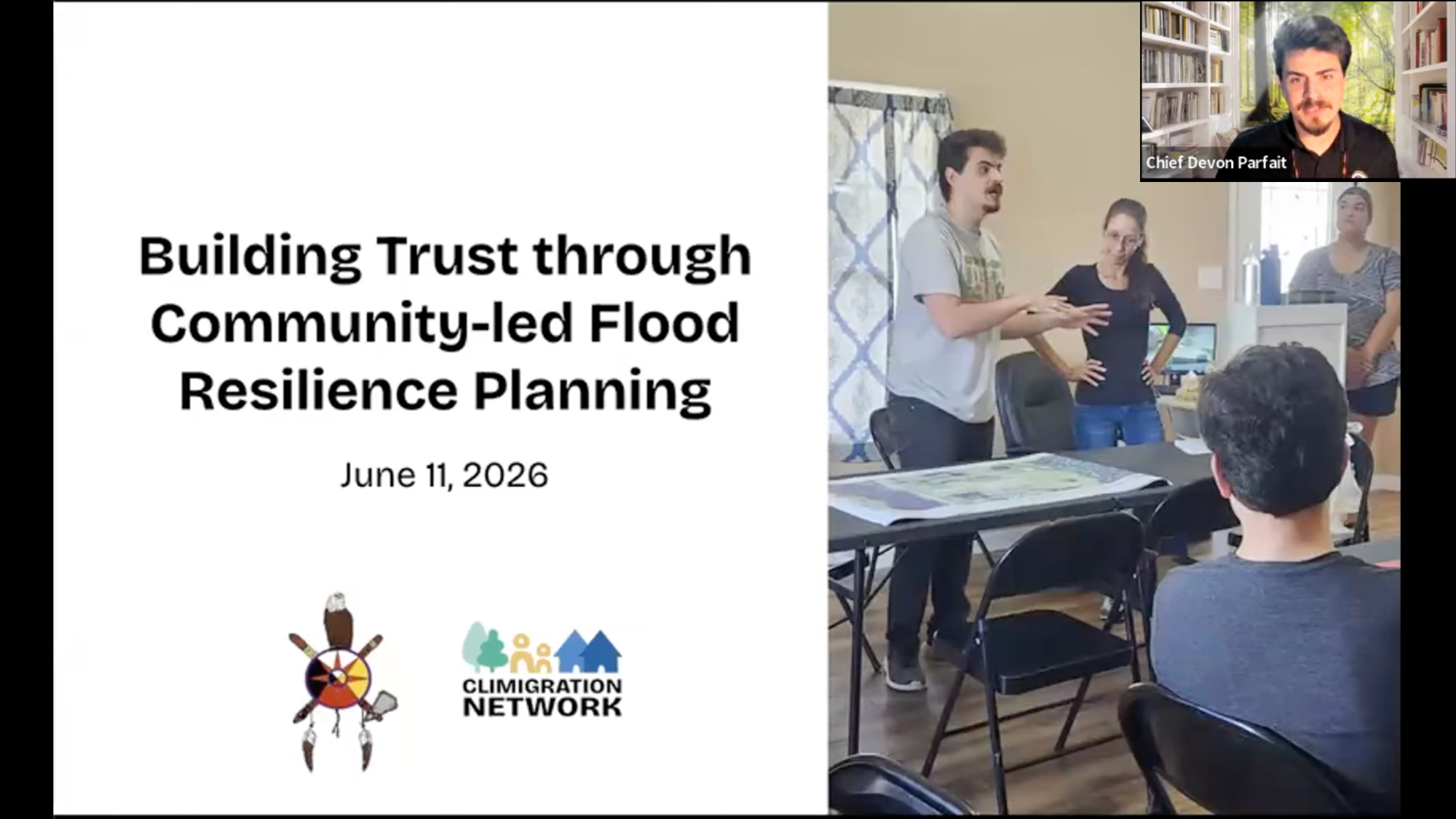
A screenshot from the virtual workshop.
On 6/11/26, the Hudson Valley Flood Resilience Network hosted an interactive virtual workshop with presentation from Chief Devon Parfait, Grand Caillou/Dulac Tribe, and facilitation from Kristin Marcell, Climigration Network.
Without considering a wider range of community and institutional knowledge and engagement, adaptation and resilience planning can damage relationships, sow distrust, or fail due to a lack of energy and support from residents, local government and thought leaders.
Co-designing projects with residents and community partners, and creating space for them to guide and lead project and engagement design, can create challenges, and might make the work slow, but it can also dramatically and positively shift perspectives and priorities, while opening up new opportunities to advance shared goals.
The Climigration Network and the Grand Caillou/Dulac Tribe are partnering to support a community-led resilience planning process for rural communities within the state-recognized Tribe’s boundaries in coastal Louisiana. They shared their experience and facilitated a discussion with participants to consider the following questions:
How can practices that don’t truly engage residents and community and Indigenous leaders damage relationships and trust and perpetuate harm?
What makes a good partnership? What do you value in partners?
What strategies could shift the conversation?
This workshop started with insights and perspectives from Devon Parfait, the Tribal Chief of the Grand Caillou/Dulac Tribe in coastal Louisiana. The discussed moved into group workshopping on partnership values (not recorded), and wrapped up with Q&A, strategies, and practical insights and tools the Tribe is using to overcome common barriers to resilience planning, including approaches transferable to local leaders in New York.
The team shared two PDF resources, which are available to use and adapt, with appropriate attribution:
Grand Caillou/ Dulac Tribe: Respectful Engagement Toolkit - by the Grand Caillou/Dulac Band of Biloxi-Chitimacha-Choctaw. The Grand Caillou/Dulac (GC/D) Tribe and their partners have developed an engagement toolkit to ensure respectful and meaningful collaboration. This toolkit establishes pathways for agencies, organizations, and individuals to engage appropriately.
Model Declaration of Principles template - by the First People’s Conservation Council, LIKEN Institute and Lowlander Center of Louisiana. These principles are based on collaborative problem-solving and co-learning as a dynamic process in which all participants work together, with the goal of balancing the differences in power among the collaborating parties.
This program was supported by funding from The Nature Conservancy's Climate Resilience Grant Program.
***
The Hudson Valley Flood Resilience Network connects local governments committed to taking actionable steps to manage current and future flood risks. The Flood Resilience Network is co-facilitated by New York Sea Grant and the Hudson River Watershed Alliance.
Hudson Valley Flood Resilience Network programs and trainings are open to Members and Partners. Members are representatives from municipal and county governments in the Hudson River estuary watershed. This includes elected and appointed officials, staff, and volunteers. Partners are staff from agencies, regional organizations, or private-sector consulting firms working in the Hudson River estuary watershed that support Members’ flood resilience goals.
To join the Network and gain access to upcoming programs, visit https://www.hvfloodresiliencenetwork.org/join and complete the Member or Partner form based on your role. The Network is free to join.